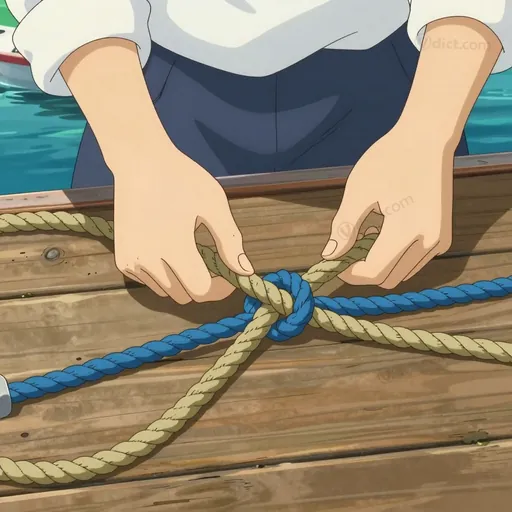
sheet bend
Noun: A type of knot used to securely join two ropes together, especially when the ropes are of different thicknesses or materials. It is specifically designed for tying a rope to the middle of another rope or to a fixed loop (an "eye").
The sheet bend is a fundamental and reliable knot for connecting two lines. It is crucial to ensure the tails (the loose ends) are long enough and that the knot is properly dressed (tightened and arranged neatly) for maximum security. - Use a sheet bend to attach the thinner cord to the thicker anchor line. - The sheet bend is often preferred over a square knot for joining ropes of unequal diameter.
- Double Sheet Bend: A more secure variation where the working end makes an extra turn around the loop. This is recommended for slippery synthetic ropes or for a more permanent join.
- For the nylon rope, tie a double sheet bend to prevent it from slipping.
- Becket bend: Another name for the sheet bend.
- Weaver's knot: A historical name for this knot, originating from its use in weaving.
- Bend (n): In knot-tying terminology, a "bend" is a class of knots used specifically to join two rope ends.
- Join: (general) to connect two things.
- Hitch: (specific) a knot used to tie a rope to another object, like a post or ring. (Note: While the definition calls it a "hitch," it is technically classified as a "bend" for joining two ropes.)
- To tie a sheet bend: The action of forming this specific knot.
- Can you tie a sheet bend to connect these two lines?
The sheet bend is not typically used in idiomatic expressions. Its meaning is strictly technical, relating to practical knot-tying in sailing, climbing, camping, and other fields.
-
a hitch used for temporarily tying a rope to the middle of another rope (or to an eye)
Khám phá thêm
Các từ liên quan
Từ đồng nghĩa